
Freight Forwarders in Miami & Florida: Trade Lane Guide 2026
At a Glance
Florida is the strongest freight forwarder location in the United States for Latin America and Caribbean trade because three regional gateways concentrate the country's outbound and inbound flows for that region. Port Everglades is the number one US port trading with the Caribbean and the number two trading with Latin America, with approximately 90 percent of its cargo moving to and from these markets. PortMiami's cargo mix is 48 percent Latin America and Caribbean, 31 percent Asia, and 20 percent Europe. Miami International Airport handles 83 percent of all US air cargo imports from Latin America and the Caribbean and 79 percent of US air exports to the region. Choosing a freight forwarder in Florida means routing through the densest network of carriers, terminal operators, customs brokers, and agent partnerships for these trade lanes.
Key Takeaways
- PortMiami handled 1,115,058 TEUs in fiscal year 2025, with 48 percent of trade tied to Latin America and the Caribbean, 31 percent to Asia, and 20 percent to Europe across 13 shipping lines and three cargo terminal operators.
- Port Everglades handled 1,167,552 TEUs in fiscal year 2025 and is the number one US port trading with the Caribbean, accounting for about 26 percent of the region's cargo, and Florida's leading petroleum and perishables port.
- Miami International Airport handled nearly 3.5 million tons of freight in 2025, ranking as the busiest US airport for total freight and the third busiest in the world, with 35-plus all-cargo carriers.
- The Miami Customs District, covering Miami-Dade, Broward, and Palm Beach counties, produced $144 billion in trade in 2024, with top export markets in Brazil, Colombia, and the Dominican Republic.
- 83 percent of US air cargo imports from Latin America and the Caribbean move through MIA, and 79 percent of US air exports to the region depart from MIA, making the airport the single most important Western Hemisphere air cargo gateway.
- A Florida freight forwarder's value comes from agent network depth, multilingual operations, multimodal coverage across ocean and air, and FMC and IATA accreditation rather than from geographic proximity alone.
Why Florida Is the United States Gateway for Latin America and Caribbean Trade
Choosing a freight forwarder is almost always a trade-lane decision. The right partner for an exporter shipping consumer goods to Vietnam is rarely the right partner for an exporter shipping construction equipment to the Dominican Republic, even when both forwarders are competent and FMC-licensed. The infrastructure, the carrier relationships, the agent network at destination, and the institutional knowledge of each trade lane vary by US region. For shippers with cargo moving to or from Latin America, the Caribbean, or transatlantic destinations with Latin America connections, Florida is the United States gateway. The state's two leading container ports, the busiest US freight airport, and the concentration of customs brokers, agents, and bilingual operations specialists in the Miami metropolitan area give Florida-based freight forwarders structural advantages that forwarders elsewhere cannot replicate by adding bilingual staff or opening a sales office. The infrastructure base, network density, and operational depth across the Limco Logistics Florida operation and other established Miami forwarders is the substantive difference.
The Three Pillars of Miami's Cargo Gateway Position
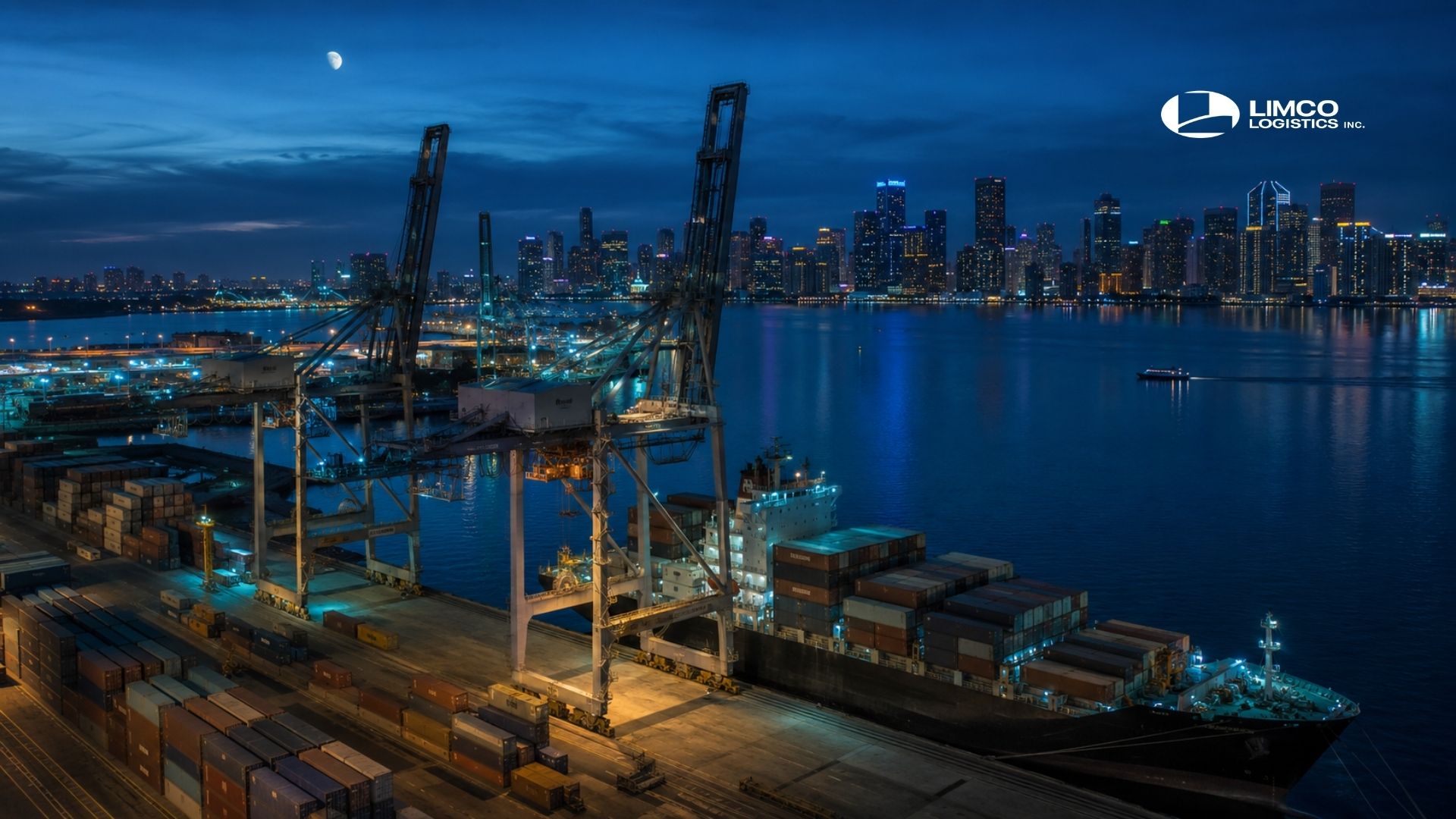
Three commercial infrastructures define Florida's freight forwarding advantage. PortMiami carries international container trade. Port Everglades carries Caribbean container trade, petroleum, and perishables. Miami International Airport carries international air freight at a volume that exceeds every other US airport. They sit within roughly 30 miles of each other, and a competent Florida-based freight forwarder routes shipments across all three depending on cargo and destination.
PortMiami: International Container Trade
PortMiami, operated by Miami-Dade County, handled 1,115,058 TEUs in fiscal year 2025 (October 2024 through September 2025), recording its eleventh consecutive year above the one-million-TEU threshold. The port's cargo mix is roughly 48 percent Latin America and Caribbean, 31 percent Asia, and 20 percent Europe and the Mediterranean. Thirteen shipping lines call the port, including the top five global container carriers (CMA CGM, COSCO, Hapag-Lloyd, Maersk, and MSC), and three cargo terminal operators handle vessel and yard operations: Port of Miami Terminal Operating Company, Seaboard Marine, and South Florida Container Terminal. PortMiami is Florida's leading container port for international trade and the eleventh largest in the United States by TEU volume.
Port Everglades: The Caribbean Container Leader
Port Everglades, in Broward County, handled 1,167,552 TEUs in fiscal year 2025, setting a container volume record. The port is the number one US port trading with the Caribbean (approximately 26 percent of the region's cargo, more than 266,000 TEUs annually) and the number two US port trading with Latin America (roughly 10 percent of the trade, more than 437,000 TEUs). Approximately 90 percent of Port Everglades trade moves to or from Latin America and the Caribbean, the highest concentration of any major US container port. The port serves more than 150 ports in 70 countries, ranks as the fifteenth busiest container port in the United States, and is the number one Florida gateway for perishables, handling more than 147,000 TEUs of refrigerated cargo in fiscal year 2025. About 80 percent of inbound cargo remains within an 80-mile radius of the port, which structurally aligns Port Everglades with the South Florida consumer market while also keeping it the natural origin point for outbound Caribbean trade.
Miami International Airport: The Busiest US Freight Airport
Miami International Airport (MIA), under the Miami-Dade Aviation Department, handled nearly 3.5 million tons of freight in 2025, up 13.6 percent year over year and a sixth consecutive record year. MIA is the busiest US airport for total freight (overtaking Memphis and Louisville in 2025) and the third busiest in the world behind only Hong Kong and Shanghai. The airport positions itself as the Gateway of the Americas, and the data supports the framing: 83 percent of all US air cargo imports from Latin America and the Caribbean move through MIA, and 79 percent of US air exports to the region depart from MIA. The airport supports 35-plus all-cargo carriers and 42 freighter airlines (charter and scheduled), with major freighter operators including Atlas Air, Avianca, LATAM, UPS, and FedEx. A $14 billion capital improvement program is underway, including a Vertical Integrated Cargo Community project that will eventually bring total cargo capacity to 5 million tons per year, and a new Phytosanitary Treatment and Cold Chain Processing Facility scheduled to open in 2027.
The Miami Customs District: $144 Billion in Trade
The Miami Customs District spans Miami-Dade, Broward, and Palm Beach counties and produced $144 billion in trade during 2024, up 5 percent year over year. Top US export markets through the district are Brazil, Colombia, and the Dominican Republic, with top US export categories including aircraft parts, medical devices, and telephones. Imports are dominated by perishables from Latin America. The district's combined trade across PortMiami, Port Everglades, MIA, and the Port of Palm Beach makes it one of the largest US customs districts measured by international commerce value.
How to Evaluate a Florida or Miami Freight Forwarder for Your Trade Lane
Not every forwarder with a Florida address is a Florida-specialized forwarder. The eight criteria below separate genuine Florida operational capability from a Florida mailing address. Each criterion is verifiable. Each one carries operational consequences for shipment cost, transit reliability, and customs clearance speed.
1. FMC License and NVOCC Bond Verification
Any forwarder offering ocean freight services must carry a Federal Maritime Commission license and a posted NVOCC bond. Verify the license number directly on the FMC's public Service Contracts database. Forwarders operating without active FMC registration cannot legally issue bills of lading for US-origin ocean cargo. The FMC license number should appear on the forwarder's website, contracts, and bills of lading.
2. Trade-Lane Vessel Coverage from PortMiami, Port Everglades, and JAXPORT
Ask which carriers the forwarder books on which lanes. A forwarder serious about Latin America and Caribbean exports should have established booking relationships with Seaboard Marine, King Ocean, Crowley Maritime, CMA CGM, MSC, Hapag-Lloyd, ZIM, and other lines operating frequent Florida-departing services. For RoRo and high-and-heavy cargo through Jacksonville or other US ports, the forwarder's coverage should extend beyond South Florida. Confirm that the forwarder books the trade lane in both directions, not just inbound or outbound.
3. Air Freight Capability Through MIA
Florida's air freight advantage is wasted on a forwarder that only handles ocean. The Miami air cargo market runs on 42 freighter airlines and a dense network of ground-handling companies. A forwarder positioned for Latin America trade should hold IATA accreditation as a Cargo Agent, have established booking relationships across Atlas Air, Avianca, LATAM, and the major belly-cargo passenger carriers, and operate inside one of MIA's recognized cargo cities.
4. Customs Broker Integration
US export shipments require AES filing through the Automated Export System, generating an Internal Transaction Number (ITN) that appears on the bill of lading. Import shipments require entry filing with US Customs and Border Protection. A Florida forwarder operating at scale either operates an in-house customs brokerage or has a tightly integrated partner brokerage in Miami. Ask whether AES filings and CBP entries are handled in-house or by a sub-contractor, and how the data flows between the forwarder and the broker.
5. Multilingual Operations Capability
Miami-Dade County's workforce reflects the trade lane. Forwarders serving Latin America at scale operate in English and Spanish at minimum, with Portuguese coverage for Brazil-bound cargo and increasingly Mandarin coverage for Asia trade. Multilingual capability is not a marketing claim; it shows up in documentation accuracy, in real-time customs dispute resolution, and in the ability to coordinate live with destination agents during their working hours rather than waiting for the next business day.
6. Agent Network Depth at Destination
The destination agent is the freight forwarder's hands at the discharge port or arrival airport. A Florida forwarder serving Latin America should be able to name the destination agent in each major country: who handles Dominican Republic clearance at Caucedo, who handles Colombian arrivals at Cartagena or Buenaventura, who handles Brazilian arrivals at Santos or Suape, who handles Mexican imports at Veracruz or Altamira. Vague answers indicate a thin agent network that increases the chance of clearance delays.
7. Multimodal Capability Across Ocean, Air, and Project Cargo
A Florida forwarder serving an exporter with mixed cargo categories needs all four ocean methods (FCL, LCL, RoRo, refrigerated) plus air freight under a single roof, supported by project cargo capability for oversized equipment. Forwarders that book FCL container shipping but subcontract air freight to a different forwarder fragment the shipper's relationship and reduce booking flexibility. For heavy equipment and project cargo exporters, the forwarder's ability to combine RoRo freight services with flat rack and breakbulk options across multiple US ports is the operational differentiator. The pre-shipment discipline behind heavy equipment export planning matters more than the eventual booking, and a competent Florida forwarder integrates the planning conversation upstream of the rate request.
8. Technology Stack: Tracking, Quoting, and EDI Integration
Modern forwarders publish customer-facing tracking portals, online quote tools, and EDI integration with shippers' ERP systems. Ask whether the forwarder provides real-time milestone updates (booking confirmed, container released, vessel sailed, arrival notice, customs cleared, delivery completed), whether tracking is by booking number, container number, AWB number, or bill of lading number, and whether the forwarder accepts EDI booking and invoice flows for repeat shippers.
Florida Versus Other US Freight Forwarder Locations
A trade-lane-by-trade-lane comparison clarifies when Florida is the strongest choice and when a different US gateway makes more sense. The table below summarizes the comparison.
| Trade Lane | Strongest US Forwarder Location | Why |
|---|---|---|
| Latin America (Brazil, Argentina, Chile, Peru, Colombia) | Florida (Miami) | Highest concentration of Latin America carriers, agents, Spanish and Portuguese language operations, MIA air capacity, and PortMiami plus Port Everglades container coverage |
| Caribbean (Dominican Republic, Jamaica, Haiti, Trinidad, Bahamas) | Florida (Miami and Fort Lauderdale) | Port Everglades is the number one US port trading with the Caribbean. MIA carries the bulk of US Caribbean air cargo |
| Mexico (USMCA partner) | Texas (Houston, Laredo) and Florida co leadership | Texas cross border land freight dominates USMCA trade. Florida leads for Mexico ocean and air container traffic outside USMCA preferences |
| Europe and Mediterranean | East Coast (NY/NJ, Baltimore) with Florida as secondary | Northeast ports have higher European vessel rotation frequency. Florida is competitive for Southern Europe and Mediterranean lanes |
| West Africa | East Coast (Baltimore, Brunswick) with Houston for project cargo | RoRo and breakbulk volume to West Africa concentrates through Baltimore and Brunswick. Houston anchors project cargo to Lagos and Tema |
| Asia (China, Japan, Korea, Vietnam, Thailand) | West Coast (Long Beach, Los Angeles, Oakland) | Trans Pacific container vessel rotations are concentrated at San Pedro Bay ports |
| Heavy equipment and project cargo to multiple regions | Depends on destination | Houston for Latin America and West Africa breakbulk. Brunswick and Baltimore for RoRo. Long Beach for Asia |
For exporters whose cargo mix and destination set cross multiple categories, the routing question is less about choosing the right US gateway and more about choosing the right freight forwarder who can route across US gateways. A Florida-based forwarder with operational reach into the top US ports for heavy equipment exports handles multi-port shipments without forcing the shipper to engage separate forwarders per US region.
Limco Logistics: Our Florida Footprint and Capabilities
Limco Logistics, founded in 2004 and headquartered in North Miami, Florida, operates as an FMC-licensed NVOCC and freight forwarder with operational support out of an Odessa, Ukraine office. The Florida headquarters anchors the company's Latin America, Caribbean, and transatlantic operations. The Odessa office anchors the company's Eastern European and CIS coverage. Together they provide multilingual operations across English, Spanish, and Russian, which corresponds to the trade lanes Limco serves at depth.
Service capabilities include ocean freight (FCL, LCL, RoRo, and refrigerated container shipping), air freight (standard, express, and time-critical), project cargo and breakbulk for oversized equipment, customs coordination including AES filing and entry support, and end-to-end documentation handling. Limco's cargo flows from US ports including PortMiami, Port Everglades, Jacksonville, Baltimore, Brunswick, Houston, Long Beach, New York and New Jersey, and Norfolk depending on cargo type and destination.
Industry verticals served at depth include agricultural exports and cold chain commodities, pet food and pet care product exports, automotive exports including used and auction vehicles, oil and gas project cargo, relief goods and humanitarian cargo for NGO programs, and construction machinery and heavy equipment exports across all four ocean methods. Limco moves cargo from US ports and airports to more than 130 countries with established agent partnerships in each major Latin America, Caribbean, European, and CIS destination.
Frequently Asked Questions
What makes Miami a top US city for freight forwarders?
Miami concentrates three of the United States' most important international cargo gateways within roughly 30 miles: PortMiami (1.1-plus million TEUs in fiscal year 2025), Port Everglades (1.16-plus million TEUs in fiscal year 2025), and Miami International Airport (3.5 million tons of freight in 2025, the busiest US freight airport). The Miami Customs District produces $144 billion in international trade annually, with 48 percent of PortMiami's cargo, 90 percent of Port Everglades' cargo, and 83 percent of MIA's Latin America and Caribbean air imports all flowing through the metropolitan area. The density of carriers, customs brokers, agents, and multilingual operations specialists in Miami exceeds every other US city for these trade lanes.
How do I choose a freight forwarder in Florida?
Eight criteria separate genuine Florida operational capability from a Florida address. Verify the freight forwarder's Federal Maritime Commission license and NVOCC bond, confirm trade-lane vessel coverage with named carriers from PortMiami and Port Everglades, check Miami International Airport air freight capability and IATA accreditation, confirm customs broker integration for AES filing and CBP entries, validate multilingual operations across English, Spanish, and where relevant Portuguese, ask for destination agent names in each country served, confirm multimodal capability across ocean, air, and project cargo, and review the forwarder's tracking and EDI integration. A forwarder that scores well on these eight criteria is operationally distinct from one that merely has a Florida mailing address.
Are Florida freight forwarders best for shipping to Latin America?
For shipments moving to or from Latin America and the Caribbean, Florida-based freight forwarders generally offer structural advantages that forwarders elsewhere cannot replicate, including denser carrier rotations from PortMiami and Port Everglades, dominant air cargo capacity through MIA (83 percent of US imports and 79 percent of US exports for the region), Spanish and Portuguese language operations at scale, and established destination agent networks across Brazil, Colombia, Peru, Chile, Argentina, Mexico, the Dominican Republic, and the broader Caribbean. The picture changes for Asia, Northern Europe, or African destinations beyond the regional flows, where other US gateways may carry stronger vessel rotations.
What is the difference between PortMiami and Port Everglades for freight forwarding?
PortMiami is the larger and more globally diversified container port, with 1,115,058 TEUs in fiscal year 2025 and a cargo mix of 48 percent Latin America and Caribbean, 31 percent Asia, and 20 percent Europe. PortMiami is served by the top five global container lines (CMA CGM, COSCO, Hapag-Lloyd, Maersk, MSC) and is Florida's leading container port for international trade. Port Everglades is more specialized for Caribbean and Latin America trade (approximately 90 percent of cargo) and is the number one US port trading with the Caribbean. Port Everglades also leads Florida in petroleum throughput (131.8 million barrels in fiscal year 2025) and in perishables (more than 147,000 TEUs of refrigerated cargo). The two ports are complementary rather than competing, and a Florida freight forwarder typically routes through both depending on cargo type and destination.
Why is Miami International Airport important for freight forwarding?
Miami International Airport is the busiest US airport for total freight (3.5 million tons in 2025) and the third busiest in the world behind only Hong Kong and Shanghai. The airport handles 83 percent of all US air cargo imports from Latin America and the Caribbean and 79 percent of US air exports to the region, making it the single most important Western Hemisphere air cargo gateway. The airport supports 35-plus all-cargo carriers and 42 freighter airlines, with carriers including Atlas Air, Avianca, LATAM, UPS, and FedEx. For freight forwarders serving Latin America and the Caribbean, MIA capacity is not a secondary capability; it is foundational to competitive service.
Does Limco Logistics handle freight forwarding for specific industries and trade lanes?
Limco serves multiple industry verticals from its North Miami headquarters across all four ocean methods (FCL, LCL, RoRo, refrigerated), air freight (standard, express, time-critical), and project cargo for oversized equipment. The company is an FMC-licensed NVOCC operating in English, Spanish, and Russian, with active trade lanes covering Latin America, the Caribbean, Europe, the Mediterranean, the Middle East, West Africa, the CIS region, and Asia-Pacific. Industry verticals served at depth include agricultural exports, pet food and pet care products, automotive exports including used and auction vehicles, oil and gas project cargo, relief goods and humanitarian cargo for NGO programs, and construction machinery and heavy equipment exports.
Choosing the Right Florida Freight Forwarder for Your Trade Lane
Florida's cargo gateway position is structural, not promotional. The state's two leading container ports moved more than 2.2 million combined TEUs in fiscal year 2025. Miami International Airport handled 3.5 million tons of freight, the busiest US airport for total freight. The Miami Customs District produced $144 billion in international trade. Forwarders operating with depth in Florida route through this infrastructure every day across Latin America, the Caribbean, Europe, the Mediterranean, the Middle East, and beyond. Limco Logistics is an FMC-licensed NVOCC and freight forwarder headquartered in North Miami, moving FCL, LCL, RoRo, refrigerated, air, and project cargo from US ports and airports to more than 130 countries. To get a quote for an upcoming export or import shipment, request a quote from the form at the top of this page or contact the Limco Miami office for trade-lane and forwarder-evaluation guidance specific to your cargo and destination.
