
Air Freight vs Ocean Freight: How to Choose the Right Mode for Your Cargo
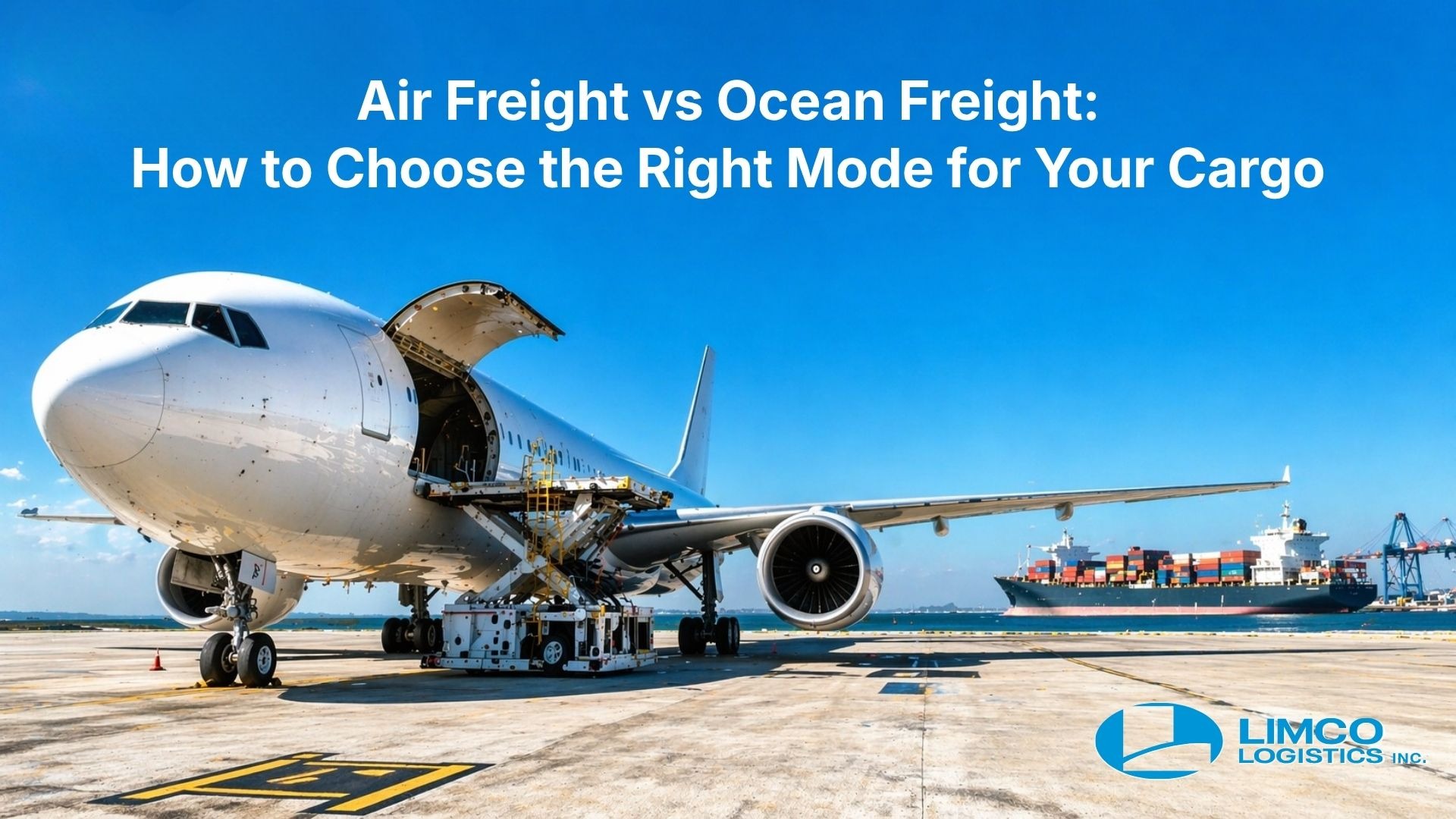
Air freight is the right choice when speed is the priority and the cargo's value or urgency justifies the higher per-kilogram cost. Ocean freight is the right choice when volume is large, lead time allows, and cost efficiency is the primary objective. The decision is not about which mode is better in the abstract. It is about which mode fits your cargo's dimensions, weight, delivery timeline, and total landed cost for that specific shipment on that specific trade lane.
Almost every international importer and exporter reaches this question at some point in their supply chain planning. Some shipments make the choice obvious: a pallet of pharmaceutical samples that must arrive in four days has no viable ocean option. A 40-foot container of steel components heading to a construction site on a 90-day lead time does not need air freight. But most shipments live somewhere between those two extremes, and the right answer depends on variables that change with every booking.
Limco Logistics coordinates both international air freight and full-service ocean freight across more than 132 countries. This guide covers the practical differences between both modes, the specific scenarios where each is the correct choice, how costs are calculated differently for each, and the documentation that applies to each. The goal is to give importers and exporters a clear framework for making this decision confidently before the booking conversation begins.
What Air Freight and Ocean Freight Actually Are
Air freight is the movement of goods by aircraft, either in the belly hold of a passenger aircraft or aboard a dedicated freighter. The cargo is measured and charged based on chargeable weight, which accounts for both the actual gross weight and the volumetric weight of the shipment. Cargo travels from the origin airport to the destination airport, where it goes through customs clearance before being released for onward delivery. The process is fast, security screening is rigorous, and the physical capacity of any single aircraft is limited compared to a container vessel.
Ocean freight is the movement of goods by container ship across sea lanes. It is the dominant mode of international cargo transport by volume, handling the vast majority of global trade goods by weight and quantity. Cargo moves in standardized containers of defined sizes, either as a full container load where one shipper has exclusive use of the box, or as a less than container load where cargo from multiple shippers is consolidated. The vessel transit time is considerably longer than air, but the capacity per shipment is exponentially larger and the cost per unit of cargo is substantially lower.
Both modes require a freight forwarder to coordinate bookings, prepare documentation, manage customs filings at origin and destination, and arrange inland transport at either end. The choice between them is made before the forwarder is engaged, and it should be made based on the actual characteristics of the shipment rather than habit or assumption about which mode the company usually uses.
Air Freight vs Ocean Freight: Side by Side
The table below addresses the factors that matter most when choosing a shipping mode for an international cargo movement. Each row is a decision variable that applies differently depending on the shipment characteristics.
| Factor | Air Freight | Ocean Freight |
|---|---|---|
| Transit speed | Days. Major international routes typically clear within 3 to 7 days including customs at destination. | Weeks. Depending on the lane, ocean transit alone is 10 to 35 days before port processing and customs. |
| Cost per unit of cargo | Significantly higher. Air freight is typically 4 to 6 times more expensive per kilogram than ocean for the same lane. | Lower. Ocean freight is the most cost efficient mode for high volume, non urgent cargo at scale. |
| How cost is calculated | By chargeable weight: the higher of actual gross weight or volumetric weight (L x W x H in cm divided by 6,000). | FCL: flat rate per container. LCL: per CBM or per metric ton, whichever is greater. |
| Best cargo weight range | Most cost effective for cargo under 500 kg, though larger consolidations up to several tonnes are common. | Practical from small LCL shipments upward to full container loads of dozens of tonnes. |
| Cargo size limits | Limited by aircraft door dimensions and weight limits. Oversized cargo cannot be shipped by air. | Can accommodate oversized, out of gauge, and extremely heavy cargo using flat rack or open top containers. |
| Primary shipping document | Air Waybill (AWB). Non negotiable document issued by the carrier, covering the air leg only. | Bill of Lading (B/L). Can be negotiable or non negotiable, covering the ocean leg and potentially multimodal movements. |
| Security screening | Rigorous. All air cargo undergoes security screening. Known Shipper status can expedite this process. | Less intensive on cargo itself. Container integrity and manifest accuracy are the primary controls. |
| Cargo visibility | High. Air shipments move quickly through a defined sequence of airport handling steps, making tracking straightforward. | Good. Modern container tracking covers vessel position, port arrival, and discharge, with some gaps between port events. |
| Best cargo types | High value goods, time sensitive products, pharmaceuticals, perishables with short shelf life, electronics, emergency restocking. | Bulk goods, raw materials, consumer goods, heavy machinery, vehicles, furniture, and any cargo where speed is not the constraint. |
| Environmental impact | Significantly higher carbon footprint per tonne kilometer than ocean freight. | Lower carbon footprint per tonne kilometer. The more sustainable mode for high volume cargo. |
When Air Freight Is the Right Choice
Air freight earns its cost premium in specific, well-defined scenarios. In each of these situations, the speed of air freight directly reduces a risk or cost that makes the higher freight rate worthwhile on a total landed cost basis.
Time-critical supply chain gaps
When a production line is at risk of stopping because a critical component has not arrived, the cost of downtime almost always exceeds the premium for air freight. The same applies to a retail launch that requires inventory on shelves by a fixed date that ocean transit cannot reach. In these situations, air freight is not a premium choice. It is the operationally necessary one, and the decision is made by the deadline rather than the rate sheet.
High-value, low-volume cargo
Electronics, precision instruments, pharmaceuticals, jewelry, and luxury goods share a common characteristic: their value is high relative to their weight and volume. For this category, the per-kilogram air freight rate translates to a small percentage of the cargo's total value, making the cost acceptable. At the same time, air transit reduces the time these goods spend in transit, which lowers inventory financing costs, reduces the window for loss or damage, and enables faster availability in the destination market.
Perishable cargo with short shelf life
Fresh-cut flowers, certain fresh fruits and vegetables, and pharmaceutical biologics all have shelf lives that may be shorter than ocean transit times on many routes. When the cargo cannot survive the ocean voyage in a condition that meets the buyer's or regulatory requirement at destination, air freight is the only viable mode. Limco Logistics coordinates temperature-controlled cargo movements across both ocean and air modes, and advises on which option matches the commodity's actual shelf life against the transit time for the specific route.
Urgent restocking during peak demand
Seasonal demand spikes, promotional events, and unexpected stockouts create situations where a company's ocean freight replenishment cycle is too slow to respond. Air freight fills that gap by moving smaller, targeted quantities of the most urgently needed inventory directly into the distribution network within days. This is not a replacement for ocean freight as the bulk replenishment strategy. It is a complement to it, used selectively when the cost of being out of stock exceeds the premium for speed.
New market entries and product launches
When a company is entering a new market or launching a product for the first time, the initial inventory quantity is typically small and the timing is commercially significant. Air freight moves that first inventory quickly, allowing the company to begin selling while the main ocean freight replenishment pipeline is established. The air freight cost on a small trial quantity is usually a minor line item compared to the revenue opportunity the launch represents.
When Ocean Freight Is the Right Choice
Ocean freight is the default mode for the majority of international trade for a straightforward reason: it is the only practical way to move large volumes of cargo economically across long distances. The scenarios below describe when ocean freight is not just the cheaper option but the correct operational one.
High-volume, non-urgent replenishment
Consumer goods, building materials, raw materials, components for manufacturing, and furniture are all examples of cargo categories where the volume is high, the value per kilogram is moderate, and the supply chain allows for the lead time that ocean transit requires. For these shipments, paying the air freight premium would add cost without delivering any operational benefit. Ocean freight delivers the same goods to the same destination at a fraction of the total freight cost.
Heavy and oversized cargo
Machinery, industrial equipment, vehicles, and out-of-gauge cargo that cannot fit within the physical constraints of an aircraft have no air freight option regardless of urgency. Ocean freight, particularly RoRo for wheeled cargo and flat rack or open-top containers for oversized items, is the only viable mode. The question is not air versus ocean for this cargo. It is which ocean freight configuration fits the specific dimensions and destination.
Bulk commodity movements
Agricultural products, steel, chemicals, and other bulk commodities move by ocean because the volume involved and the economics of the commodity make air freight financially impossible. A consignment of grain, a shipment of industrial chemicals, or a container of steel coils has a per-unit value that cannot absorb the air freight rate regardless of how the math is structured. Ocean freight is the only mode that makes these global commodity flows viable.
Shipments where total cost is the constraint
For importers working within tight margin structures where freight cost is a significant component of the total landed cost, ocean freight preserves the commercial viability of the product. A furniture importer, a textile buyer, or a consumer goods company sourcing from Asia to the US market cannot absorb air freight rates across the volume they move without eliminating the price advantage that makes the sourcing strategy viable in the first place. The decision to use ocean freight in these cases is a business model requirement, not just a cost preference.
For businesses comparing FCL and LCL options within ocean freight, the Limco Logistics guide covering LCL vs FCL shipping provides a detailed breakdown of how to choose between shared and dedicated container options based on cargo volume and the destination timeline.
How Air Freight and Ocean Freight Costs Are Structured Differently
Understanding how each mode calculates freight cost is essential for comparing quotes accurately. A lower rate in isolation means nothing if it is applied to a different base than the competing mode's rate.
How air freight cost is calculated
Air freight is priced on chargeable weight. This is the higher of two figures: the actual gross weight of the shipment in kilograms, or the volumetric weight calculated by dividing the cargo's total cubic centimeters by 6,000. A shipment that is physically light but takes up a lot of space, such as packaged goods with significant void space in the carton, will be charged on its volumetric weight rather than its actual weight. This is why cargo density matters in air freight in a way it does not in ocean FCL booking.
Limco Logistics provides an air cargo calculation tool that lets shippers input their cargo dimensions and weight to understand the chargeable weight before requesting a quote. Knowing the chargeable weight in advance avoids surprises when the invoice arrives and enables an accurate comparison between air and ocean options.
How ocean freight cost is calculated
Ocean freight for FCL shipments is priced as a flat rate per container, covering the specific container type (20ft, 40ft, 40ft High Cube) between the origin and destination port pair. The shipper pays for the container regardless of how full it is, which means partial use of a container on an FCL booking is a cost inefficiency. For LCL shipments, the rate is applied per CBM or per metric ton, whichever is greater, to the shipper's actual cargo volume.
Beyond the base ocean freight, both FCL and LCL shipments carry additional charges at origin and destination: terminal handling, documentation fees, customs filing, and inland transport. These are separate from the freight rate itself and must be included in any accurate total cost comparison between air and ocean options.
How Documentation Differs Between Air Freight and Ocean Freight
Both modes require export and import customs documentation, a commercial invoice, and a packing list. Where they differ is in the primary shipping document issued by the carrier.
Air Waybill for air freight
The Air Waybill (AWB) is the primary carrier document for air freight shipments. It serves as the contract of carriage between the shipper and the airline, a receipt for the cargo, and a declaration of the shipment contents. The AWB is a non-negotiable document, meaning it cannot be used as a title document to transfer ownership of the goods while they are in transit. For importers expecting to sell or trade cargo in transit, this is an important distinction from ocean freight. The Limco Logistics AWB company glossary provides a detailed reference for the terminology and fields used across air waybill documentation.
Bill of Lading for ocean freight
Ocean freight shipments are covered by a Bill of Lading, which can be either a negotiable original (allowing the cargo to be traded while at sea by transferring the document) or a non-negotiable sea waybill. The choice between these document types has implications for how the importer takes possession of the cargo at destination and whether the goods can be pledged as security to a bank during the ocean transit. The Limco Logistics resource on Bill of Lading terms covers the legal framework governing ocean carrier responsibility on every shipment.
Incoterms and who controls the documentation
Regardless of whether a shipment moves by air or ocean, the Incoterm agreed in the commercial contract determines who arranges and pays for freight, insurance, and customs at each stage. When a buyer purchases under DDP terms, the seller is responsible for delivering to the buyer's door including paying import duties. Limco Logistics coordinates Delivery Duty Paid service for importers who need a fully landed, duties-cleared delivery without managing the customs process themselves, across both air and ocean shipments.
Using Air and Ocean Freight Together: The Practical Approach for Most Businesses
For most importers and exporters who move cargo regularly, the choice between air and ocean is not a one-time structural decision. It is a shipment-by-shipment assessment that changes based on inventory levels, seasonal demand, market conditions, and lead time availability at any given moment.
The most effective approach for businesses with ongoing import or export programs is to use ocean freight as the primary replenishment mode, planned around the lead times that container vessel schedules require, and air freight as the responsive supplement when speed is necessary and the cargo quantity justifies the cost. This hybrid model keeps the base freight cost at the ocean rate while retaining the flexibility to respond quickly when the supply chain needs it.
Setting up this kind of split-mode program requires a freight forwarder who operates competently in both modes, maintains carrier relationships on your specific trade lanes for both air and ocean, and can advise you on which mode fits each shipment as conditions change. The considerations for evaluating a forwarder's capability across both modes are the same as those covered in the Limco Logistics guide on how to choose an international freight forwarder, which is worth reviewing before structuring any ongoing multi-mode logistics relationship.
Limco Logistics manages both modes for clients across multiple sectors, providing a single point of coordination for shipments that alternate between air and ocean depending on the quarter's inventory requirements. The team advises on mode selection for each movement based on the current market conditions on the specific lane rather than a default recommendation that applies regardless of context.
Not Sure Whether Air or Ocean Is Right for Your Next Shipment?
Limco Logistics coordinates international air freight and ocean freight across more than 132 countries. Share your cargo details, weight, dimensions, and destination and the team will recommend the right mode with a full cost comparison for both options.
Get a Mode Comparison QuoteAir or Ocean: A Practical Decision Guide
Use the scenarios below as a quick reference when a shipment decision needs to be made without a full analysis. These are generalizations that apply to the majority of standard commercial cargo situations.
Choose Air Freight When
- Delivery is required within days, not weeks
- The cargo is lightweight and compact relative to its value
- The goods are perishable with a shelf life shorter than ocean transit
- A supply chain emergency requires urgent replenishment
- The cargo is high value and transit security is a priority
- You are launching a product and need a small quantity fast
Choose Ocean Freight When
- The cargo volume fills or approaches a full container
- The lead time allows for a multi week transit window
- The cargo is heavy, dense, or oversized
- The per unit value of the goods is moderate and cost efficiency is critical
- The shipment is a bulk commodity or raw material
- You need to move goods that exceed aircraft capacity limits
Frequently Asked Questions
What is the main difference between air freight and ocean freight?
The primary difference is speed versus cost. Air freight moves goods by aircraft and is the fastest international shipping mode, with transit times measured in days. Ocean freight moves goods by container ship and is significantly slower, with transit times measured in weeks, but it is far more economical for large or heavy cargo. Air freight is typically 4 to 6 times more expensive per unit of cargo than ocean, which makes ocean the default choice for high-volume non-urgent shipments and air the choice for time-sensitive or high-value goods.
When should I use air freight instead of ocean freight?
Use air freight when your cargo is time-sensitive and cannot wait for the ocean transit window, when the goods are high-value and the cost of air is justified by the reduction in inventory financing and storage time, when the cargo is lightweight enough that the per-kilogram rate is manageable, when you are shipping perishables with a shelf life shorter than ocean transit, or when an urgent supply chain disruption requires replenishment faster than ocean freight allows.
Is air freight always faster than ocean freight?
Yes, in terms of transit time. Air freight on major international routes delivers within 3 to 7 days including customs clearance. The equivalent ocean freight on the same routes takes 14 to 35 days. However, the total door-to-door timeline for both modes also includes cargo pickup, pre-shipment documentation, and inland transport at destination. Air freight's speed advantage applies clearly to the transport leg itself, with the overall timeline still depending on how efficiently the surrounding steps are coordinated.
How is air freight cost calculated compared to ocean freight?
Air freight is charged on chargeable weight: the higher of actual gross weight or volumetric weight (calculated by dividing the cargo's total cubic centimeters by 6,000). Ocean FCL freight is a flat rate per container regardless of how full it is. Ocean LCL is charged per CBM or per metric ton, whichever is greater. Cargo that is bulky but light is often more expensive by air due to volumetric weight, while dense heavy cargo generally moves more economically by ocean.
What cargo is not suitable for air freight?
Cargo unsuitable for air freight includes very heavy or oversized industrial equipment exceeding aircraft capacity, bulk commodities such as raw materials, metals, and agricultural products where volume is high and urgency is low, goods whose per-unit value does not justify the higher per-kilogram rate, and certain hazardous materials restricted on commercial aircraft. For these categories, ocean freight is the appropriate and practical shipping mode.
Can I use both air freight and ocean freight for the same supply chain?
Yes. Many importers use ocean freight as the primary bulk replenishment mode and air freight for urgent restocking, seasonal peaks, or supply chain emergencies. This hybrid approach keeps the base freight cost at the ocean rate while retaining the flexibility to respond quickly when the business needs it. A freight forwarder who manages both modes on your trade lanes can coordinate this split-mode approach as part of a single logistics relationship.
The Right Mode Is a Shipment Decision, Not a Company Policy
The most common mistake importers and exporters make in freight mode selection is treating it as a fixed policy rather than a per-shipment decision. A company that always ships by ocean regardless of urgency leaves itself exposed to supply chain disruptions it cannot respond to. A company that defaults to air freight for convenience pays a cost premium that compounds across every shipment it did not need to rush.
The right framework is straightforward: assess the cargo's weight and volume, determine the deadline at destination, calculate the cost difference between modes for the specific trade lane, and choose the mode where the total landed cost and operational outcome are most aligned with the business need. That assessment changes with every shipment. A forwarder who covers both modes and advises honestly on which fits each movement is one worth keeping.
Limco Logistics operates international air freight and ocean freight services across more than 132 countries, providing mode recommendations based on the specific characteristics of each shipment rather than a default preference. The team manages documentation, customs coordination, and carrier booking for both modes, giving clients a single point of accountability regardless of whether the cargo moves by aircraft or container ship.
Ready to Ship? Let Limco Logistics Recommend the Right Mode
Share your cargo specifications, origin, destination, and timeline. Limco Logistics will compare both options and recommend the mode that delivers the right balance of speed and cost for your shipment.
Request Your Freight Comparison Quote