
Exporting Construction Equipment and Heavy Machinery
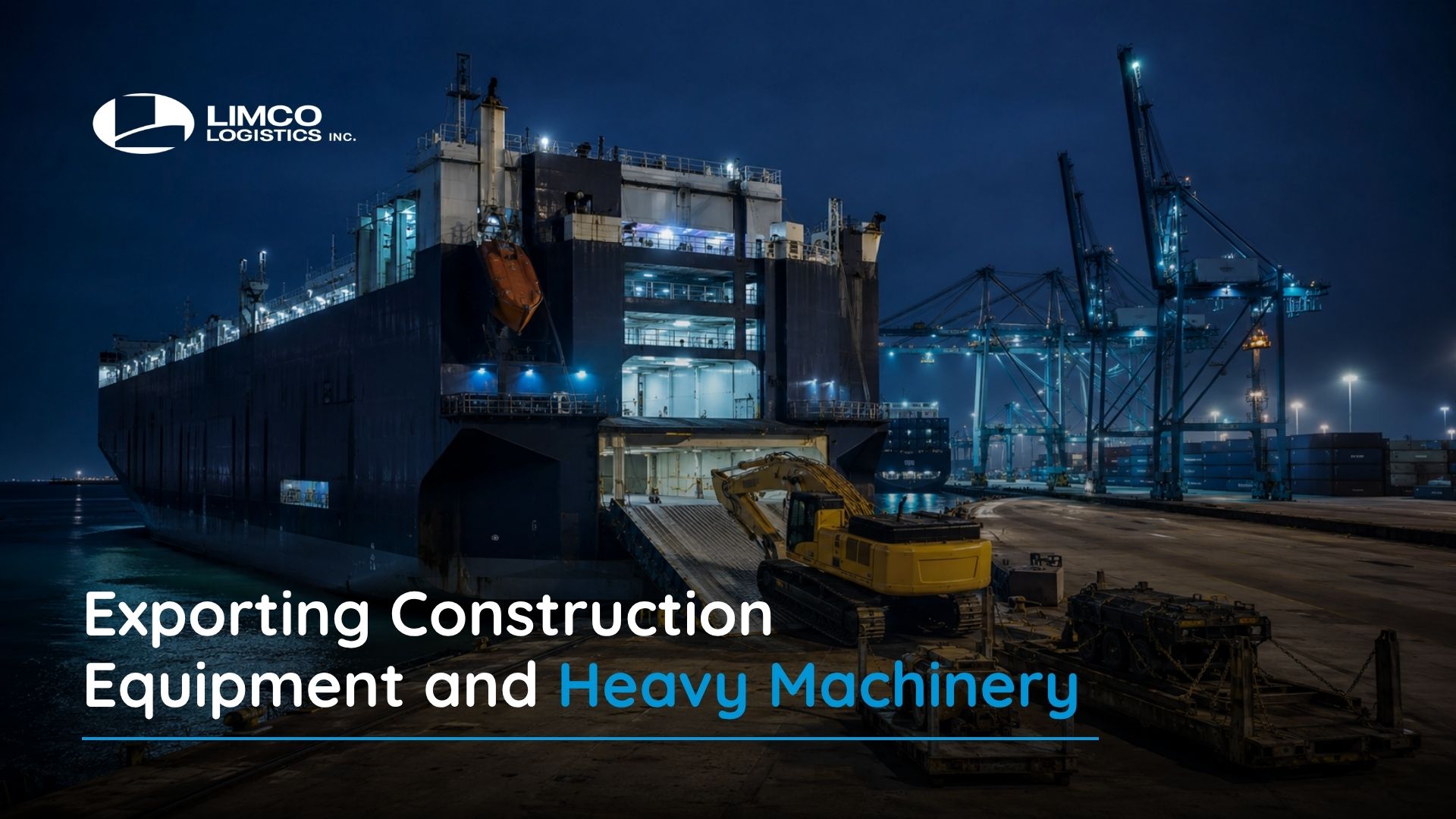
Construction equipment and heavy machinery move from US ports by four primary ocean methods: RoRo (roll-on, roll-off) for self-propelled cargo, flat rack containers for oversized but lift-able units, breakbulk for project cargo too large for any container, and FCL containers for smaller equipment or disassembled components. The best method depends on each unit's weight, dimensions, mobility, and the destination port's handling capability. US exporters most often route project cargo through Houston, Baltimore, Brunswick, Jacksonville, Long Beach, and Galveston, supported by documentation that includes the commercial invoice, packing list, EEI filing through AES, and the bill of sale or title for self-propelled units.
Key Takeaways
- RoRo is the default method for self-propelled equipment when both the US loading port and the destination port have RoRo terminal capability.
- Flat rack containers handle cargo that is too oversized for a standard box but does not justify a breakbulk vessel call.
- Breakbulk vessels accept the largest and heaviest equipment and are scheduled per loading port and trade lane rather than on fixed weekly rotations.
- US ports with established heavy-lift and project cargo capability include Houston, Baltimore, Brunswick, Jacksonville, Galveston, Long Beach, New Orleans, Norfolk, and Beaumont.
- Documentation for used construction equipment exports must include serial numbers, hour meter readings, condition evidence, and an Electronic Export Information filing with an Internal Transaction Number.
- ISPM-15 compliance for wood crating and EPA Tier engine compliance for certain destinations are common checkpoints that drive booking decisions.
Why Multi-Method Knowledge Matters for US Heavy Equipment Exporters
US exporters who move construction equipment and heavy machinery rarely ship a single unit type to a single destination. A typical procurement cycle for an overseas contractor combines hydraulic excavators, wheel loaders, articulated dump trucks, generator sets, and oversized accessories that arrive on different chassis and require different ocean handling. Choosing the wrong shipping method for even one unit in a multi-category procurement order causes port handling rebooks, missed vessel calls, and customs holds at the destination. The four ocean methods covered here, RoRo, flat rack containers, breakbulk vessels, and standard FCL containers, each handle a different slice of the equipment portfolio. The exporter who understands which method fits which unit, and which US port has the right combination of vessel schedules and shore-side handling capability, controls the timeline and the cost structure of the entire export.
What Counts as Construction Equipment and Heavy Machinery for Export?
For US export purposes, construction equipment and heavy machinery span four broad operational categories that route differently through ocean shipping:
Self-propelled rolling equipment
Tracked and wheeled units that can be driven under their own power, including hydraulic excavators, bulldozers, wheel loaders, motor graders, articulated dump trucks, telehandlers, backhoe loaders, skid steers, mobile cranes, agricultural tractors, asphalt pavers, road rollers, and motor scrapers. These units are the natural fit for RoRo because they roll on the vessel without rigging.
Oversized but lift-eligible equipment
Equipment that exceeds the internal dimensions of a standard container but can be lifted by a gantry or mobile crane at the port, including disassembled wheel loaders, smaller crawler cranes, drilling rig sections, hydraulic breakers, and prefabricated steel structures. These units route through flat rack containers (typically 20-foot or 40-foot open-frame platforms) or by breakbulk depending on the destination.
Static and modular project cargo
Cargo that is neither rolling nor easily contained, including hydraulic mining shovels, large stationary crushers, modular processing plants, transformers, conveyor systems, generator sets above standard container capacity, and engine packages for power plants. This category goes by breakbulk vessel, sometimes with project cargo chartering for very large single units.
Components and attachments
Buckets, undercarriage parts, engine blocks, hydraulic cylinders, transmissions, GET (ground engaging tools), and replacement parts. These ship by standard FCL or LCL container and frequently accompany the parent unit in a coordinated multi-unit procurement.
Most multi-category procurement orders combine all four categories in the same shipment window, which is why coordinating method-by-method routing on a single bill of lading or coordinated booking package matters more than picking a single mode for the whole order.
The Four Primary Ocean Shipping Methods for Heavy Equipment from the USA
Method 1: RoRo (Roll-On, Roll-Off)
RoRo vessels carry wheeled and tracked cargo that is driven directly onto multiple internal decks through a stern or side ramp, then secured at designated tie-down points using rated chains and turnbuckles. Self-propelled equipment that meets axle weight, deck-height, and ramp clearance limits is the natural fit for RoRo freight services, where each unit is driven aboard and stowed below deck without container or cradle. The advantage is loading speed: a wheel loader rolls aboard in minutes whereas the same unit on a flat rack requires crane time, rigging, lashing inspection, and surveyor sign-off. RoRo also avoids the dimensional overhead of putting non-stackable equipment into a container. The constraint is route coverage. Not every destination has a RoRo terminal, and even where one exists, the specific vessel calling that port may not accept tracked cargo or may have weight limits below your unit. The execution layer matters as much as the routing decision, which is one reason serious shippers treat RoRo execution for vehicles and heavy equipment in 2026 as a separate operational discipline rather than a commodity booking.
Method 2: Flat Rack Containers
Flat rack containers are open-frame steel platforms with fixed end-walls but no sides or roof, available in 20-foot, 40-foot, and 40-foot high-cube variants. They are loaded by crane lift, secured with chains and turnbuckles to dedicated lashing eyes, and stowed on container vessels in the same slot positions as regular boxes when configured for over-height or out-of-gauge cargo. Flat rack is the bridge between containerized shipping and breakbulk: it accepts cargo that is too tall, too wide, or oddly shaped for a standard container but small enough that a full breakbulk vessel call is not justified. Specifications including frame dimensions, loading capacity, and over-height tolerances are summarized in Limco's reference for container dimensions across standard and specialized equipment. Flat rack is the workhorse for partially disassembled wheel loaders, drilling rig sections, prefabricated steel, and any single unit between roughly 5 metric tons and the rated capacity of a 40-foot flat rack.
Method 3: Breakbulk Vessel
Breakbulk vessels carry individual cargo units loaded directly into the cargo hold or onto open deck space, secured by purpose-rigged lashing under the vessel operator's stowage plan. This is the method for hydraulic mining shovels, large rigid dump trucks, stationary crushers, modular processing units, transformer packages, and any cargo that exceeds flat rack capacity or that needs heavy-lift cranage at both the loading and discharge ports. Breakbulk runs on scheduled vessel calls per trade lane rather than weekly fixed-day rotations, which means the booking window opens months ahead and slot availability is finite. The advantage is that breakbulk handles cargo no other method can move. The constraint is that origin port, vessel, and destination port must all align, and the booking process is project-managed rather than transactional.
Method 4: FCL Container Shipping
Standard FCL container shipping handles smaller construction equipment that fits inside a 20-foot or 40-foot dry box, including skid steers, mini excavators, smaller telehandlers, attachments, components, engine packages, and replacement parts. The shipping economics of FCL container shipping are usually the most predictable across all four methods because container vessels run on fixed weekly schedules to most major trade lanes. For multi-category procurement orders, components and smaller attachments routinely move FCL alongside the parent unit's RoRo or flat rack booking, which means an exporter typically books two or three methods on the same shipment week rather than choosing one.
How Do RoRo, Flat Rack, Breakbulk, and FCL Container Methods Compare?
The decision among the four methods rests on six variables: cargo eligibility, vessel and port availability, preparation effort, loading speed, securing complexity, and transit predictability. Limco's overview of the operational tradeoffs across these methods, RoRo, flat rack, and breakbulk method selection, expands on the comparison logic below.
Criterion
RoRo
Flat Rack
Breakbulk
FCL Container
Best for
Self propelled wheeled or tracked equipment
Oversized but lift eligible units
Project cargo, mining shovels, modular plant
Smaller equipment, components, attachments
Loading method
Driven aboard via stern or side ramp
Crane lift onto open frame
Crane lift directly into hold or onto deck
Forklift or driven into box
Preparation effort
Low: fluid reduction, battery disconnect, securing point check
Medium: partial disassembly, dimension reduction, rigging plan
High: full lifting plan, route survey, surveyor coordination
Low to medium: stuffing plan, internal blocking and bracing
Vessel schedule
Fixed weekly or biweekly rotations on RoRo trade lanes
Same as container vessels, weekly on major lanes
Per trade lane, scheduled per vessel call
Fixed weekly on all major trade lanes
US port availability
Baltimore, Brunswick, Jacksonville, Galveston, Long Beach
Wherever container vessels call
Houston, Baltimore, New Orleans, Norfolk, Long Beach
All major US container ports
Securing complexity
Standardized tie down at designated deck points
Diagonal and lateral lashing to flat rack frame
Custom lashing plan per cargo unit
Internal bracing inside the container
| Criterion | RoRo | Flat Rack | Breakbulk | FCL Container |
|---|---|---|---|---|
| Best for | Self propelled wheeled or tracked equipment | Oversized but lift eligible units | Project cargo, mining shovels, modular plant | Smaller equipment, components, attachments |
| Loading method | Driven aboard via stern or side ramp | Crane lift onto open frame | Crane lift directly into hold or onto deck | Forklift or driven into box |
| Preparation effort | Low: fluid reduction, battery disconnect, securing point check | Medium: partial disassembly, dimension reduction, rigging plan | High: full lifting plan, route survey, surveyor coordination | Low to medium: stuffing plan, internal blocking and bracing |
| Vessel schedule | Fixed weekly or biweekly rotations on RoRo trade lanes | Same as container vessels, weekly on major lanes | Per trade lane, scheduled per vessel call | Fixed weekly on all major trade lanes |
| US port availability | Baltimore, Brunswick, Jacksonville, Galveston, Long Beach | Wherever container vessels call | Houston, Baltimore, New Orleans, Norfolk, Long Beach | All major US container ports |
| Securing complexity | Standardized tie down at designated deck points | Diagonal and lateral lashing to flat rack frame | Custom lashing plan per cargo unit | Internal bracing inside the container |
Which Method Fits Which Equipment Type?
The shortcut decision is to start from the equipment specification sheet and work outward to the routing options. The questions in order are: Can the unit be driven? Does the unit fit inside a standard container? Does the unit exceed flat rack rated capacity? Is the destination port equipped for the chosen method? Pre-shipment planning for multi-category orders is where the largest cost and timeline savings happen, which is why structured heavy equipment export planning precedes the booking conversation rather than following it.
For a typical mixed procurement order combining excavators, wheel loaders, attachments, and a generator set, the routing logic resolves as follows. The excavators and wheel loaders ride RoRo if both the US port and the destination port have RoRo capability and the units fit ramp clearance limits. The generator set, depending on dimensions, either fits on a flat rack or moves breakbulk. Bucket attachments, undercarriage parts, and components consolidate in an FCL container. Where RoRo is unavailable on the destination side, the self-propelled units shift to flat rack if dimensions allow, or to breakbulk if they do not.
Which US Ports Handle Heavy-Lift and Project Cargo?
Ten US ports carry the majority of construction equipment and project cargo exports, each anchored to different trade lanes and vessel rotations:
- Port of Houston, Texas. The largest US project cargo and breakbulk port by tonnage. Strong vessel schedules to Latin America, the Caribbean, West Africa, and the Middle East. Heavy-lift cranage and deep-water berths support outsize cargo.
- Port of Baltimore, Maryland. The largest US RoRo port for construction and agricultural equipment. Direct vessel rotations to Europe, West Africa, the Mediterranean, and the Persian Gulf. Deep-water berthing with on-dock rail access.
- Port of Brunswick, Georgia. Second largest US RoRo terminal for heavy machinery and vehicles. Vessel rotations to West Africa, Europe, the Middle East, and Australasia.
- Port of Jacksonville, Florida. RoRo and breakbulk capability serving Caribbean, Latin America, West Africa, and Asia. Used by exporters routing through the US Southeast.
- Port of Galveston, Texas. Project cargo and breakbulk capability supporting Gulf of Mexico industrial exports and Latin America trade.
- Port of New Orleans and Port of South Louisiana. Mississippi-River-system project cargo handling for inland-originating equipment moving by barge to deep-water vessels.
- Port of Long Beach and Port of Los Angeles, California. The primary West Coast gateway for heavy equipment exports to Asia-Pacific markets, with breakbulk and project cargo handling alongside container operations.
- Port of Norfolk, Virginia. RoRo, breakbulk, and project cargo capability for East Coast originating cargo bound for Europe, the Mediterranean, and the Middle East.
- Port of Savannah, Georgia. Container and breakbulk operations supporting Southeast US exporters with strong Asia-Pacific and European trade lane coverage.
- Port of Beaumont, Texas. Heavy-lift and project cargo specialty port for the energy sector and large-scale industrial equipment exports.
The choice among these ports is rarely about distance from origin alone. It is driven by vessel schedule frequency to the destination port, available cranage for the cargo's lifting requirements, and whether the trade lane has a RoRo, flat rack, or breakbulk service running in the booking window the exporter needs.
How Is Heavy Equipment Lashed and Secured for Ocean Transit?
Cargo securing for heavy equipment ocean transit follows the International Maritime Organization Code of Safe Practice for Cargo Stowage and Securing, known as the IMO CSS Code, supplemented by each vessel operator's cargo securing manual and the trade lane's marine surveyor practices. The principle is that lashing strength must exceed the worst-case dynamic forces the cargo will experience in transit, which for the North Atlantic, North Pacific, and Cape of Good Hope routes can include sustained vessel motion in heavy weather.
For RoRo decks, self-propelled units are positioned at designated tie-down points with parking brakes engaged, transmissions in low gear or park, and rated chains attached from the deck securing points to the equipment's lashing eyes. Standard practice is a minimum of four chains per unit, configured so that the lashing pattern resists fore-aft, athwartship, and vertical lift forces simultaneously. The number of chains scales with the unit's weight and the operator's published lashing matrix.
For flat rack cargo, the lashing pattern uses diagonal and lateral chains anchored to the flat rack's perimeter lashing eyes, supplemented by hardwood dunnage blocks and chocks that prevent shifting within the frame. The flat rack itself is secured to the vessel deck by standard twist locks at the corner castings, the same as a regular container.
For breakbulk cargo, the lashing plan is written cargo-by-cargo by the vessel's chief officer or the load planner, with each securing element rated and inspected. Major project cargo units typically require a marine surveyor's pre-loading inspection that documents the lashing configuration, photographs the securing, and certifies compliance before the vessel sails. The lashing certificate is part of the document package retained by the freight forwarder and referenced if any cargo claim arises during transit.
What Documentation Do US Exporters Need for Used Construction Equipment?
The documentation set for a used construction equipment export from the USA combines US export filings, commercial shipping documents, and destination-country-specific requirements. The core set every shipment carries:
- Commercial invoice. Itemized by unit, including the equipment make, model, year of manufacture, serial number, hour or kilometer reading, and declared value in US dollars. The invoice is the primary value reference for AES filing, destination customs valuation, and any insurance claim.
- Packing list. Unit-by-unit detail including dimensions, weight, and serial numbers. For multi-category orders, the packing list often runs to several pages and is the source document for the bill of lading description.
- Bill of sale or certificate of title. Required for self-propelled units. The bill of sale establishes ownership transfer; the title, where applicable, may need to be perforated or marked as exported per US Customs requirements before submission to the AES filing.
- AES filing with Internal Transaction Number. The Electronic Export Information submission through the Automated Export System generates the ITN that must appear on the bill of lading and on the commercial invoice. The filing is required for shipments above the US Foreign Trade Regulations value threshold and for any shipment requiring an export license under the Bureau of Industry and Security's Export Administration Regulations.
- Schedule B classification. The 10-digit US export commodity classification code assigned to each unit. For construction equipment, the classifications typically fall under HS Chapter 84 (machinery), with specific codes for excavators, loaders, graders, and so on.
- Certificate of origin. Required by many destination countries for customs valuation and preferential tariff treatment under applicable trade agreements.
- Bill of lading or sea waybill. The transport document issued by the carrier or NVOCC, listing the ITN, the consignee, the notify party, and the cargo description.
Destination-specific add-ons frequently include a pre-shipment inspection certificate (required by several West African and Latin American destinations), a fumigation certificate for wood crating, an ISPM-15 mark verification for all wooden dunnage and crating material, an EPA non-conformance statement where the equipment's engine does not meet the destination country's emissions tier, and country-specific labels or markings. For project cargo, the package adds a lifting plan, a route survey, and a weight certificate from a certified scale.
Common Pitfalls in Multi-Category Heavy Equipment Export Procurement
The most frequent points of failure in multi-category US heavy equipment export procurement are operational rather than commercial. Three recur across most engagements:
Underestimating the difference between vessel schedules and trade lane availability. A RoRo vessel calling Baltimore weekly may not call the destination port on the same week. A flat rack booking on a Houston-departing vessel may be subject to the container-stowage software's slot allocation logic that does not guarantee an over-height position. The booking conversation needs to confirm not only that a vessel exists, but that the specific slot, deck position, or hold accommodates the cargo as configured.
Skipping or under-specifying the pre-shipment condition record. Used construction equipment exports carry an inherent dispute risk between buyer expectations and as-delivered condition. A documented condition record (photographs, hour readings, fluid levels, operational test notes) taken at the originating yard before transport to the port is the primary defense if a buyer raises a condition claim at the destination. Missing or thin condition documentation forces the exporter into an argument they cannot win.
Treating documentation as the freight forwarder's problem alone. The AES filing, Schedule B classification, and bill of sale handling sit with the USPPI (US Principal Party in Interest), which is typically the exporter, not the forwarder. A freight forwarder files AES as the exporter's authorized agent only with a signed power of attorney and verified document inputs. The exporter who treats AES as administrative paperwork rather than as a compliance function carries the regulatory liability for any filing errors.
Frequently Asked Questions
What is the best shipping method for an excavator from the USA?
For a self-propelled tracked or wheeled excavator that meets the destination RoRo terminal's ramp clearance and axle weight limits, RoRo is usually the most operationally efficient choice. The unit is driven onto the vessel and secured below deck without rigging. For oversized excavators or destinations without RoRo terminal capability, a flat rack container or breakbulk vessel call is the alternative, with the boom often removed and shipped alongside the carrier unit to reduce overall dimensions.
Can RoRo ships handle all sizes of construction equipment?
No. RoRo vessels have published ramp capacity, deck height, and lane width limits that vary by ship and operator. Standard pure car and truck carriers handle most wheeled construction equipment up to certain axle weights, but very large hydraulic mining shovels, large rigid dump trucks, and tower-crane components typically exceed RoRo limits and route through flat rack or breakbulk instead. Always confirm the specific vessel's deck plan before assuming RoRo eligibility.
How do I prepare used heavy equipment for export from the USA?
Preparation begins with a documented condition record including photographs, hour-meter readings, and serial number verification on every component. Fluids are drained or topped to the destination port's safety threshold, batteries are disconnected, loose attachments are removed and crated, and all wood crating and dunnage must comply with ISPM-15 phytosanitary marking. Pre-shipment cleaning is required for many destinations to satisfy biosecurity inspections. The originating freight forwarder typically coordinates the pre-shipment inspection if the destination country requires one.
What documentation is required for exporting used construction equipment from the USA?
The core document set for a US used equipment export includes the commercial invoice, packing list with serial numbers and hour readings, bill of sale or title for self-propelled units, the Electronic Export Information filing through AES with the Internal Transaction Number on the bill of lading, certificate of origin, and the bill of lading or sea waybill. Destination-specific documents may include a pre-shipment inspection certificate, fumigation certificate, EPA non-conformance statement for certain engines, and a Schedule B classification consistent with the equipment's HS code.
Which US ports handle heavy-lift and project cargo?
Houston, Baltimore, Brunswick, Jacksonville, Galveston, New Orleans, Long Beach, Norfolk, Savannah, and Beaumont are the primary US ports that handle heavy-lift, project cargo, RoRo, and breakbulk loadings on a regular schedule. Each port has different equipment, vessel calls, and trade-lane coverage. Houston and Galveston serve Latin America, West Africa, and Middle East project cargo. Baltimore and Brunswick anchor East Coast RoRo and heavy-equipment trade lanes. Long Beach serves Asia-Pacific routes for heavy machinery.
How is heavy equipment secured for ocean transit?
Heavy equipment is secured following the International Maritime Organization Code of Safe Practice for Cargo Stowage and Securing (CSS Code), using rated lashing chains, turnbuckles, wire ropes, and dunnage matched to the equipment's weight and the vessel's deck securing-point ratings. Self-propelled units on RoRo decks are typically secured at designated tie-down points with parking brakes engaged and transmissions in low gear. Flat rack and breakbulk cargo is lashed with diagonal and lateral chains and braced with hardwood blocking against shifting forces during transit.
Should I drain fluids before exporting construction equipment?
Fluid handling depends on the shipping method and destination port rules. For RoRo, most operators require the fuel tank to be reduced to roughly one-quarter capacity, with no leaks, batteries disconnected, and hydraulic fluid intact. For container or flat rack shipments, fluids are typically drained or sealed depending on the vessel operator and the IMDG Code classification of any retained fluids. The originating freight forwarder confirms the specific draining and labeling protocol for each booking before equipment is delivered to the port.
Getting Your US Heavy Equipment Export Moving
Limco Logistics moves RoRo, flat rack, breakbulk, and FCL container cargo from US ports to more than 130 countries. Share your construction equipment or heavy machinery export details with our team and we will recommend the right shipping method, documentation path, and export plan for your cargo.
Request a Heavy Equipment Export Quote