
RoRo Shipping from US Ports to West Africa, Europe, and the Middle East
At a Glance
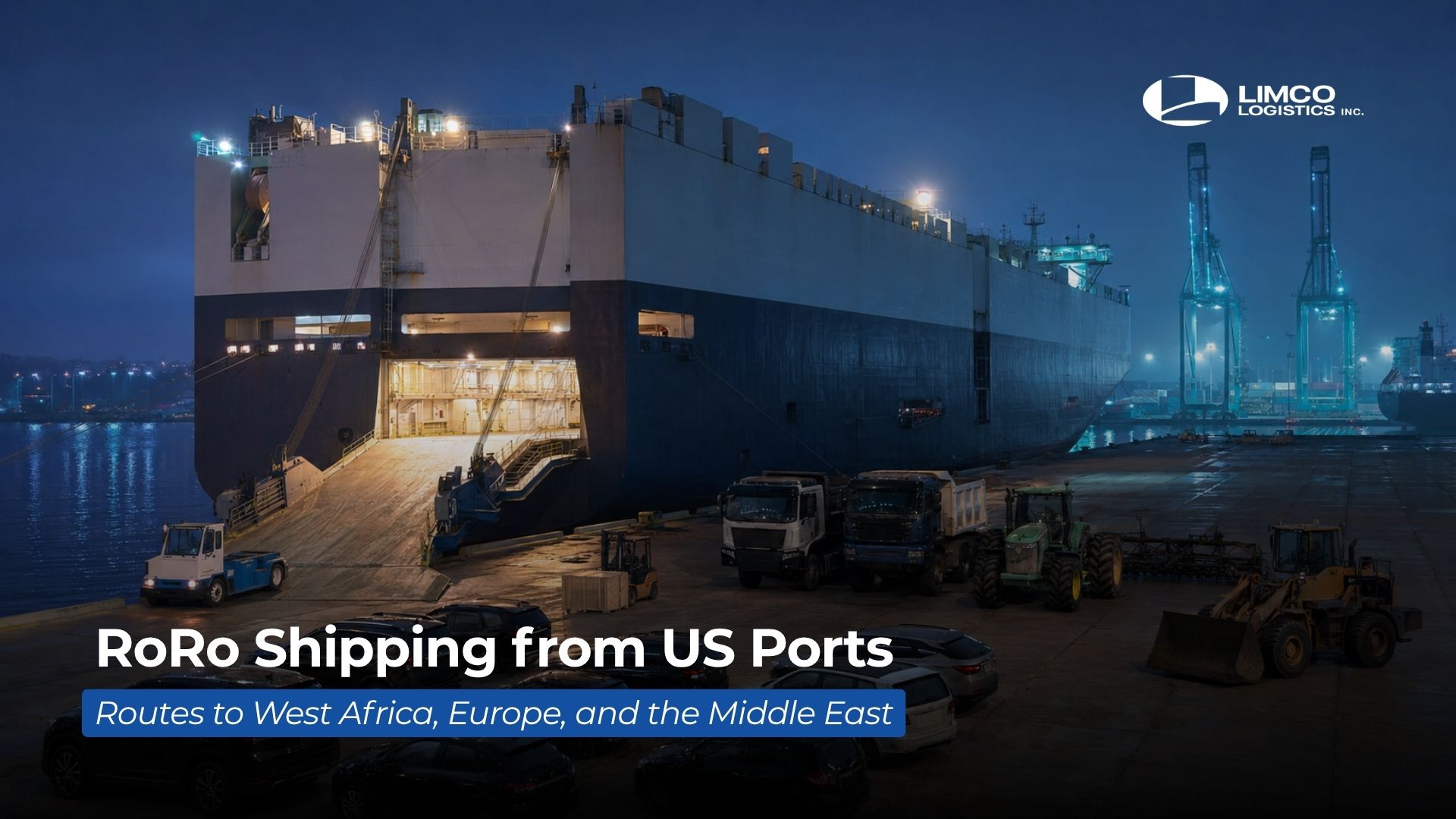
US RoRo cargo to West Africa, Europe, and the Middle East departs from a small set of dedicated RoRo terminals organized by destination region. West Africa-bound vessels load primarily at the Port of Brunswick (Colonel's Island Terminal), the Port of Baltimore (Dundalk Marine Terminal), and the Port of Jacksonville, calling at Lagos, Tema, Dakar, Abidjan, and Cotonou. Europe-bound RoRo vessels load primarily at Baltimore, Brunswick, Jacksonville, and the Port of New York and New Jersey, with discharge at Bremerhaven, Zeebrugge, Antwerp, Southampton, and Le Havre. Middle East-bound RoRo vessels load primarily at Houston, Baltimore, and Brunswick, with discharge at Jebel Ali, Jeddah, Dammam, and Khalifa Port. Vessel rotations range from weekly schedules on the busiest lanes to biweekly or monthly frequencies on niche routes, and documentation requirements vary materially by region.
Key Takeaways
- Brunswick's Colonel's Island Terminal is the nation's largest US RoRo gateway, with rotations to West Africa, Europe, the Mediterranean, and the Middle East served by Wallenius Wilhelmsen, Hoegh Autoliners, Sallaum Lines, the Grimaldi Group including Atlantic Container Line, K Line, NYK, and MOL ACE.
- Baltimore's 50-foot channel and 13-berth Dundalk Marine Terminal anchor East Coast RoRo to Europe, the Mediterranean, the Middle East, and West Africa with strong inland rail connectivity to the Midwest manufacturing belt.
- Houston anchors US-Middle East RoRo and project cargo flows through the 52-mile Houston Ship Channel, with vessel rotations to Jebel Ali, Jeddah, Dammam, and other Persian Gulf and Red Sea ports.
- Used passenger vehicles dominate US-West Africa RoRo volume, with Nigeria, Ghana, Senegal, and Côte d'Ivoire as the primary destination markets, supplemented by used trucks, motorcycles, and construction equipment.
- Pre-shipment inspection schemes (BIETC for Togo, FERI for Senegal, BESC for Cameroon, SONCAP for certain product categories entering Nigeria) apply on most West African routes and must be coordinated before vessel departure.
- GCC vehicle conformity (SASO Certificate of Conformity for Saudi Arabia under the SABER program, ESMA conformity for the UAE) and other Middle East destination-specific documents are required at booking, not at arrival.
How US RoRo Trade Lanes Are Organized by Destination Region
RoRo shipping (roll-on, roll-off) moves self-propelled and rolling cargo from a small number of dedicated US terminals to destination ports around the world. Unlike container shipping, which can be routed flexibly across most US gateways and most foreign ports, RoRo is constrained by the carrier rotations of a relatively small set of Pure Car and Truck Carrier (PCTC) operators. Vessel schedules concentrate at specific US export terminals, and discharge concentrates at specific RoRo-capable terminals abroad. The result is that RoRo trade lanes look more like scheduled liner routes than the more elastic container network: a finite set of US-to-region pairings, each with its own carrier mix, vessel rotation frequency, and documentation profile.
For US exporters of vehicles, construction equipment, agricultural machinery, project cargo, and other self-propelled cargo, choosing the right US departure port for the destination region is the first economic decision. Limco Logistics operates as an FMC-licensed NVOCC and freight forwarder for US RoRo exports across all three of the regions covered in this guide, supported by established booking relationships with the principal carriers and agent networks at the major discharge ports. The structured planning approach behind RoRo execution for vehicles and heavy equipment in 2026 sits alongside the trade-lane geography mapped in the rest of this article.
RoRo Shipping from US Ports to West Africa
The West Africa Trade Lane in Context
West Africa is one of the largest and most active US RoRo trade lanes by vessel rotation count. Used passenger vehicles drive the bulk of the volume, with Nigeria, Ghana, Senegal, Côte d'Ivoire, Togo, Benin, and Cameroon as the primary destination markets. The trade lane carries used vehicles from US dealer and auction sources (Copart, IAAI, Manheim, and similar platforms) along with used trucks, construction equipment, agricultural machinery, motorcycles, and used tires. Project cargo and oil-and-gas industry equipment routes through the same gateway ports on flat-rack or breakbulk basis when the cargo exceeds RoRo capacity.
Primary US Departure Ports for West Africa
- Port of Brunswick, Georgia (Colonel's Island Terminal). The nation's largest US RoRo gateway and the principal departure point for US-West Africa rotations. Operated by the Georgia Ports Authority, Colonel's Island has direct on-terminal rail and on-terminal vehicle processing capability for export volume.
- Port of Baltimore, Maryland (Dundalk Marine Terminal). Operated by the Maryland Port Administration. Strong East Coast and Midwest origin coverage with deep RoRo specialization including high-and-heavy cargo handling.
- Port of Jacksonville, Florida (JAXPORT). Significant RoRo capacity to West Africa with vessel rotations from Sallaum Lines, Grimaldi, and others. Strong Florida-origin cargo coverage and competitive booking for Southeast US exporters.
- Secondary: Port of New York and New Jersey, Port of Houston. Occasional RoRo coverage to West Africa from these ports, particularly for cargo origins that are inconvenient for the three primary gateways.
Primary West African Discharge Ports
- Nigeria: Lagos (Apapa and Tin Can Island terminals are the principal RoRo facilities) and Onne (Niger Delta, oil and gas focus).
- Ghana: Tema (the main RoRo terminal serving Accra and the Ghanaian interior) and Takoradi (western Ghana, project cargo focus).
- Senegal: Dakar (the principal Senegalese gateway and a regional transshipment hub).
- Côte d'Ivoire: Abidjan (the largest RoRo discharge port in francophone West Africa).
- Togo: Lomé (transshipment hub for the Sahelian interior).
- Benin: Cotonou (high used-vehicle import volume serving Benin and routing inland to landlocked markets).
- Cameroon: Douala (the principal gateway for Cameroon and Central African Republic).
Principal Carriers and Vessel Rotations
Sallaum Lines is one of the most active carriers on the US-West Africa lane with regular departures from Brunswick, Baltimore, and Jacksonville. The Grimaldi Group, including Atlantic Container Line (ACL), operates frequent US-West Africa RoRo rotations with strong coverage across Nigeria, Ghana, Senegal, and Côte d'Ivoire. Hoegh Autoliners and Wallenius Wilhelmsen serve the lane on rotations that often combine European and West African discharge ports on a single voyage. K Line, NYK, and MOL ACE add capacity on selected services. The busiest lanes (Brunswick or Baltimore to Lagos, for example) carry weekly or biweekly rotations; smaller lanes operate on biweekly or monthly cadence.
Cargo Types and Operational Notes
Used passenger vehicles purchased through US auctions and dealer channels constitute the largest single category. Limco's experience supporting automotive industry exports on this trade lane covers Copart and IAAI buyer accounts, US-side pickup and delivery to the loading port, lot photography, and documentation coordination. Used trucks (Class 7 and 8 semi-tractors are particularly active to Ghana and Nigeria), used buses, construction equipment, agricultural equipment, and used tires also move at scale. NGO and faith-based shipments of vehicles and equipment route through the same gateways as relief goods and humanitarian cargo, often with duty-waiver coordination on the destination side.
RoRo Shipping from US Ports to Europe
The Europe Trade Lane in Context
The transatlantic RoRo trade lane is the highest-frequency lane out of the US East Coast, supporting weekly schedules on most major rotations and carrying the largest tonnage of high-and-heavy cargo of any US trade lane. Vehicle volume is split between new vehicle exports (including OEM movements between US production plants and European markets) and used vehicle exports (including classic and collector cars purchased through US auction channels for European buyers). Construction equipment, agricultural machinery, motorcycles, recreational vehicles, and project cargo round out the cargo mix.
Primary US Departure Ports for Europe
- Port of Baltimore, Maryland (Dundalk Marine Terminal). The historical US East Coast leader in transatlantic RoRo and the principal departure port for Midwest-originating equipment.
- Port of Brunswick, Georgia (Colonel's Island Terminal). The current number-one US RoRo port by total volume, with strong transatlantic rotations to Germany, Belgium, the United Kingdom, and the Mediterranean.
- Port of Jacksonville, Florida (JAXPORT). Solid transatlantic coverage with weekly or biweekly carrier schedules.
- Port of New York and New Jersey. Significant RoRo capacity serving northern Europe and the United Kingdom from Mid-Atlantic and Northeast origin cargo.
- Secondary: Port of Norfolk, Virginia and Port of Charleston, South Carolina. Carrier-specific RoRo rotations on certain transatlantic services.
Primary European Discharge Ports
- Germany: Bremerhaven (the largest dedicated RoRo and vehicle handling port in Europe) and Hamburg.
- Belgium: Zeebrugge (one of Europe's principal RoRo hubs, particularly for vehicle distribution) and Antwerp.
- Netherlands: Vlissingen and Rotterdam.
- United Kingdom: Southampton (the primary UK port for vehicle imports and RoRo) and Felixstowe.
- France: Le Havre (the main RoRo and vehicle gateway for France) and Marseille (for southern France and onward Mediterranean distribution).
- Italy: Genoa, Savona, and Livorno (Mediterranean RoRo and project cargo).
- Spain: Barcelona, Santander, and Valencia.
- Poland: Gdynia and Gdańsk (growing RoRo and project cargo coverage for Central and Eastern Europe).
Principal Carriers and Vessel Rotations
Wallenius Wilhelmsen is the largest RoRo carrier on the US-Europe lane, with multiple weekly rotations across the major US East Coast departure ports. Hoegh Autoliners operates frequent transatlantic schedules with strong coverage across Bremerhaven, Zeebrugge, Antwerp, and Southampton. K Line, NYK, and MOL ACE add weekly or biweekly capacity. United European Car Carriers (UECC) operates intra-European feeder networks that distribute vehicles from the main discharge ports across the continent. The Grimaldi Group operates US-Europe RoRo rotations that combine with Mediterranean discharge ports on a single voyage. Vessel rotations on the busiest US East Coast to northern Europe lanes typically run weekly.
Cargo Types and Operational Notes
New OEM vehicle movements (where the cargo originates from a US manufacturing plant and routes to a European market) carry the largest single segment of volume. Used vehicle exports from US auction sources to European buyers, particularly classic and collector cars, are a steady high-value secondary category. Construction equipment, agricultural equipment, recreational vehicles (including motor homes), and motorcycles round out the standard cargo mix. Documentation for European destinations centers on the EORI number of the importer, the T1 or T2 customs document for in-transit movement within the EU customs union, and any product-specific certification (WLTP emissions documentation for vehicles, CE marking for equipment, EU Declaration of Conformity for regulated products). Vehicle exports to the UK following Brexit require separate UK customs and conformity documentation distinct from the EU process.
RoRo Shipping from US Ports to the Middle East
The Middle East Trade Lane in Context
The US-Middle East RoRo trade lane carries a high-value cargo mix dominated by new and used passenger vehicles (with luxury and SUV categories particularly active), construction equipment, oil-and-gas project cargo, generator sets, modular industrial plant, and specialty heavy vehicles for energy-sector operations. The Persian Gulf and Red Sea destinations carry the largest volume of US-departing RoRo cargo in the region, supplemented by Egyptian Mediterranean ports and transshipment routings to onward markets in East Africa and South Asia.
Primary US Departure Ports for the Middle East
- Port of Houston, Texas. The principal US gateway for Middle East RoRo and project cargo, with strong vessel rotations to Jebel Ali, Jeddah, Dammam, and other Persian Gulf and Red Sea ports. The Houston Ship Channel and the multi-purpose terminal complex make Houston the natural origin point for energy-sector cargo bound for GCC markets.
- Port of Baltimore, Maryland. Strong East Coast departure capacity to the Middle East via vessel rotations that often combine Mediterranean and Middle East discharge ports.
- Port of Brunswick, Georgia. Increasing US-Middle East RoRo volume as carriers add rotations from the country's largest RoRo terminal.
- Secondary: Port of Long Beach, California. Some Middle East-bound vessels rotate from Asia via the Suez Canal and call at Long Beach for West Coast-origin cargo.
Primary Middle East Discharge Ports
- United Arab Emirates: Jebel Ali (the largest container and multi-purpose port between Europe and Asia, operated by DP World, and the principal UAE gateway for RoRo); Khalifa Port (Abu Dhabi, growing RoRo capacity); Sharjah.
- Saudi Arabia: Jeddah (the principal Red Sea gateway) and Dammam (the principal Persian Gulf gateway). The two ports together cover the kingdom's east-west cargo distribution.
- Oman: Sohar and Salalah (transshipment and project cargo).
- Qatar: Hamad Port (the main Qatari gateway since 2017).
- Bahrain: Khalifa bin Salman Port.
- Kuwait: Shuwaikh and Shuaiba.
- Jordan: Aqaba (the principal Jordanian seaport with project cargo and RoRo capability).
- Egypt: Alexandria and Port Said (Mediterranean discharge points, often combined with onward routing via the Suez Canal).
Principal Carriers and Vessel Rotations
Wallenius Wilhelmsen, Hoegh Autoliners, and K Line anchor the US-Middle East RoRo lane with vessel rotations to Jebel Ali, Jeddah, and Dammam. NYK and MOL ACE add capacity on selected services. The Grimaldi Group operates combined Europe-Middle East rotations that call at Mediterranean ports en route to Jeddah and the Persian Gulf. Vessel rotations on the busiest US-Persian Gulf lanes typically run biweekly, with some carriers offering monthly direct service to Jeddah and Dammam. Combined Mediterranean and Middle East rotations add scheduling flexibility but extend overall transit on individual port pairs.
Cargo Types and Operational Notes
The cargo mix on this lane skews toward higher-value categories. New passenger vehicles, including SUVs and luxury models, route to UAE and Saudi Arabia for dealer distribution. Used vehicles purchased through US auction channels move for both private buyers and dealer re-export to onward markets. Oil-and-gas project equipment, construction machinery (including large hydraulic excavators, wheel loaders, and drilling support equipment), generators and modular plant, and specialty heavy vehicles for energy-sector operations represent the high-margin segment. For exporters whose cargo combines RoRo-eligible self-propelled units with oversized breakbulk or flat-rack pieces, the broader operational framework across the top US ports for heavy equipment exports covers the method-by-method routing decisions that determine how a mixed-cargo shipment is structured.
Comparing the Three US RoRo Trade-Lane Regions
The table below summarizes the side-by-side comparison of the three primary US RoRo trade-lane regions.
Documentation Requirements by Region
Every US RoRo shipment regardless of destination carries a standard US export document set. The destination-specific layer varies materially by region and is the most frequent cause of delayed shipments when not coordinated before booking.
Standard US Export Document Set (All Regions)
- Commercial invoice (itemized by unit, with declared value, VIN or serial number, and year of manufacture for vehicles)
- Packing list (with weights and dimensions per unit)
- Bill of sale or certificate of title for self-propelled units
- AES filing through the Automated Export System with the resulting Internal Transaction Number on the bill of lading
- Schedule B classification matched to the commodity's HS code
- Certificate of origin
- Bill of lading or sea waybill issued by the carrier or NVOCC
- ISPM-15 declaration for any wooden dunnage or crating in export use
West Africa Add-Ons
- Pre-shipment inspection certificate under the destination's verification scheme (BIETC for Togo, FERI for Senegal, BESC for Cameroon, BIC for various countries)
- SONCAP certificate for certain product categories entering Nigeria
- Vehicle age verification where the destination enforces age restrictions (Ghana, Côte d'Ivoire)
- Importer registration documentation for the consignee
Europe Add-Ons
- EORI number for the importer of record
- T1 or T2 customs document for in-transit movement within the EU customs union
- WLTP emissions documentation for vehicle imports
- CE marking and EU Declaration of Conformity for regulated equipment categories
- Separate UK customs and conformity documentation for UK-bound cargo following Brexit
Middle East Add-Ons
- SASO Certificate of Conformity issued under the SABER program for Saudi Arabia
- ESMA conformity and ECAS marking for the UAE
- GCC Vehicle Standard compliance for vehicle exports across the GCC
- Vehicle age restriction verification (UAE and Kuwait enforce age limits on used vehicles)
- Arabic translation or attested versions of key shipping documents where required by destination customs
- Halal certification for relevant cargo categories where applicable
How to Book RoRo Shipping from a US Port
The booking workflow for US-departing RoRo shipments runs through a defined sequence regardless of destination region.
- Define the cargo and destination. The freight forwarder confirms cargo type, dimensions, weight, mobility (running or non-running for vehicles), and destination port pair. RoRo eligibility is verified against the carrier's published vessel limits.
- Select the US departure port and carrier rotation. The forwarder matches the cargo and destination to a carrier vessel rotation, taking into account vessel schedule, ramp clearance limits, deck height, and onward port pair.
- Confirm pre-shipment requirements. Pre-shipment inspection schemes for West African destinations are initiated. Conformity documentation for Middle East destinations is initiated. EU emissions and conformity requirements for European destinations are verified.
- Coordinate inland transport. Cargo moves from the originating yard to the US loading port, typically by enclosed or open-deck carrier for vehicles and by flatbed or low-boy for heavy equipment.
- Complete documentation. Commercial invoice, packing list, certificate of title or bill of sale, certificate of origin, AES filing with ITN, and the destination-specific document set are finalized.
- Tender at the port. The cargo is tendered to the loading port within the carrier's published cutoff window. Pre-shipment condition documentation is taken at tender.
- Vessel loading and lashing. Self-propelled cargo is driven onto the vessel through the stern or side ramp; non-running cargo is towed. Lashing is verified by the chief mate's lashing inspection.
- Transit and destination handover. The cargo moves under the carrier's bill of lading to the destination port. Continuous visibility through real-time tracking of US-departing RoRo shipments by container, AWB, or vessel number is maintained from origination to destination handover.
- Destination clearance. The consignee or the consignee's customs broker clears the cargo at the destination port. The freight forwarder coordinates with the destination agent to confirm release and onward delivery.
For exporters whose cargo combines several RoRo-eligible units with smaller parts or attachments, the standard practice is to book the RoRo cargo on a vessel rotation while consolidating the parts into a separate FCL or LCL container on a coordinated sailing. Limco's broader RoRo freight services are structured to handle these mixed-method shipments under a single bill-of-lading coordination, which reduces the consignee's destination-side handling.
Frequently Asked Questions
Which US ports handle RoRo shipping to West Africa, Europe, and the Middle East?
US RoRo cargo to West Africa loads primarily at the Port of Brunswick (Colonel's Island Terminal), the Port of Baltimore (Dundalk Marine Terminal), and the Port of Jacksonville (JAXPORT). Europe-bound RoRo loads primarily at Baltimore, Brunswick, Jacksonville, and the Port of New York and New Jersey, with some cargo also routed through Norfolk and Charleston. Middle East-bound RoRo loads primarily at Houston, Baltimore, and Brunswick, with overflow capacity through Long Beach for vessels rotating via the Suez Canal from Asia. The choice among these gateways is driven by the originating cargo's geographic location, the carrier's vessel schedule, and the destination port pair on the routing.
Which carriers operate US RoRo vessel rotations to West Africa, Europe, and the Middle East?
The principal RoRo carriers operating US-departing vessel rotations to these regions include Wallenius Wilhelmsen, Hoegh Autoliners, Sallaum Lines, the Grimaldi Group (including Atlantic Container Line), K Line, NYK Line, MOL ACE, Eukor Car Carriers, and United European Car Carriers (UECC). Carrier coverage differs by region: Sallaum, Grimaldi, and Hoegh are particularly active on US-West Africa rotations; Wallenius Wilhelmsen, Hoegh, K Line, NYK, and MOL dominate US-Europe and US-Mediterranean lanes; and Wallenius Wilhelmsen, Hoegh, and K Line anchor US-Middle East rotations to the Persian Gulf and Red Sea ports.
How often do RoRo vessels depart US ports for these regions?
Vessel frequencies vary by trade lane and carrier rotation. The busiest US-Europe lanes from Baltimore, Brunswick, and the Port of New York and New Jersey typically run weekly schedules, with multiple carrier services on each lane. US-West Africa lanes from Brunswick, Baltimore, and Jacksonville typically run weekly to biweekly rotations depending on carrier and destination port pair. US-Middle East lanes from Houston, Baltimore, and Brunswick typically run biweekly to monthly rotations, with some carriers operating combined Mediterranean-Middle East rotations that call multiple discharge ports on a single voyage. Specific sailing schedules are confirmed at booking based on the carrier, the cargo, and the destination port pair.
What documents are required for US RoRo exports to West African destinations like Nigeria, Ghana, and Senegal?
The standard US export document set applies (commercial invoice, packing list, certificate of origin, AES filing with Internal Transaction Number, Schedule B classification, and bill of lading or sea waybill). For vehicles, the bill of sale or certificate of title is also required. West African destinations typically add a pre-shipment inspection certificate issued under the destination country's verification scheme: BIETC for Togo, FERI for Senegal, BESC for Cameroon, BIC for various countries, and the SONCAP certificate for certain product categories entering Nigeria. Some destinations enforce vehicle age restrictions; Ghana, for example, limits the age of imported vehicles, and the freight forwarder confirms eligibility before booking. Right-hand drive vehicles are not standard in West Africa, where left-hand drive vehicles dominate the market.
What documents are required for US RoRo exports to the Middle East and the GCC countries?
In addition to the standard US export document set (commercial invoice, packing list, certificate of origin, AES filing with ITN, Schedule B, and bill of lading or sea waybill), Middle East destinations layer on country-specific conformity and clearance documents. Saudi Arabia requires the SASO Certificate of Conformity issued under the SABER program for vehicles and many product categories, with import authorization through the Saudi Customs system. The UAE applies ESMA conformity requirements and ECAS marking for regulated products. Vehicle exports to most GCC countries also enforce age restrictions and must comply with the GCC Vehicle Standard. Arabic translations or attested versions of key documents are often required at destination customs, and the freight forwarder coordinates these alongside the AES filing.
What cargo types move on US-departing RoRo vessels to West Africa, Europe, and the Middle East?
RoRo vessel categories carry a wide range of self-propelled and rolling cargo across these three regions. To West Africa: used passenger vehicles dominate by volume, supplemented by used trucks, buses, motorcycles, used tires, construction equipment (excavators, wheel loaders, graders), agricultural equipment (tractors, harvesters), and humanitarian or donated vehicles routing as relief cargo. To Europe: new and used passenger vehicles (including classic and collector cars from US auctions), motorcycles, construction equipment, agricultural equipment, recreational vehicles, and project cargo on flat racks or breakbulk. To the Middle East: new and used vehicles (with luxury and SUV categories particularly active), construction and oil-and-gas project equipment, generator sets, modular plant, and specialty heavy vehicles for energy-sector operations.
Routing Your US RoRo Shipment Through the Right Trade Lane
Trade-lane geography is the single most important factor in US RoRo shipping economics. The carrier rotations, the destination port pairs, the documentation regime, and the cargo mix all change by region, and the freight forwarder routing the shipment makes the trade-lane choice work for the shipper or against them. Limco Logistics is an FMC-licensed NVOCC and freight forwarder headquartered in North Miami, with operational support out of an Odessa office, moving RoRo, flat rack, breakbulk, FCL, LCL, refrigerated, and air cargo from US ports and airports to more than 130 countries. To get a quote for an upcoming US RoRo export to West Africa, Europe, or the Middle East, request a quote from the form at the top of this page or contact the Limco Miami office for trade-lane and routing guidance specific to your cargo and destination.
Vessel rotation frequencies and carrier service patterns reflect published carrier schedules as of mid-2026. Specific sailing schedules, vessel cutoff times, and documentation requirements are confirmed at booking based on the carrier, cargo, and destination port pair.
Team Limco Logistics
